How to Get a Logo and Branding for Your Startup
Most startups handle logo and branding three ways. They use a logo maker, hire a freelance designer, or work with an agency. Here's how to pick.
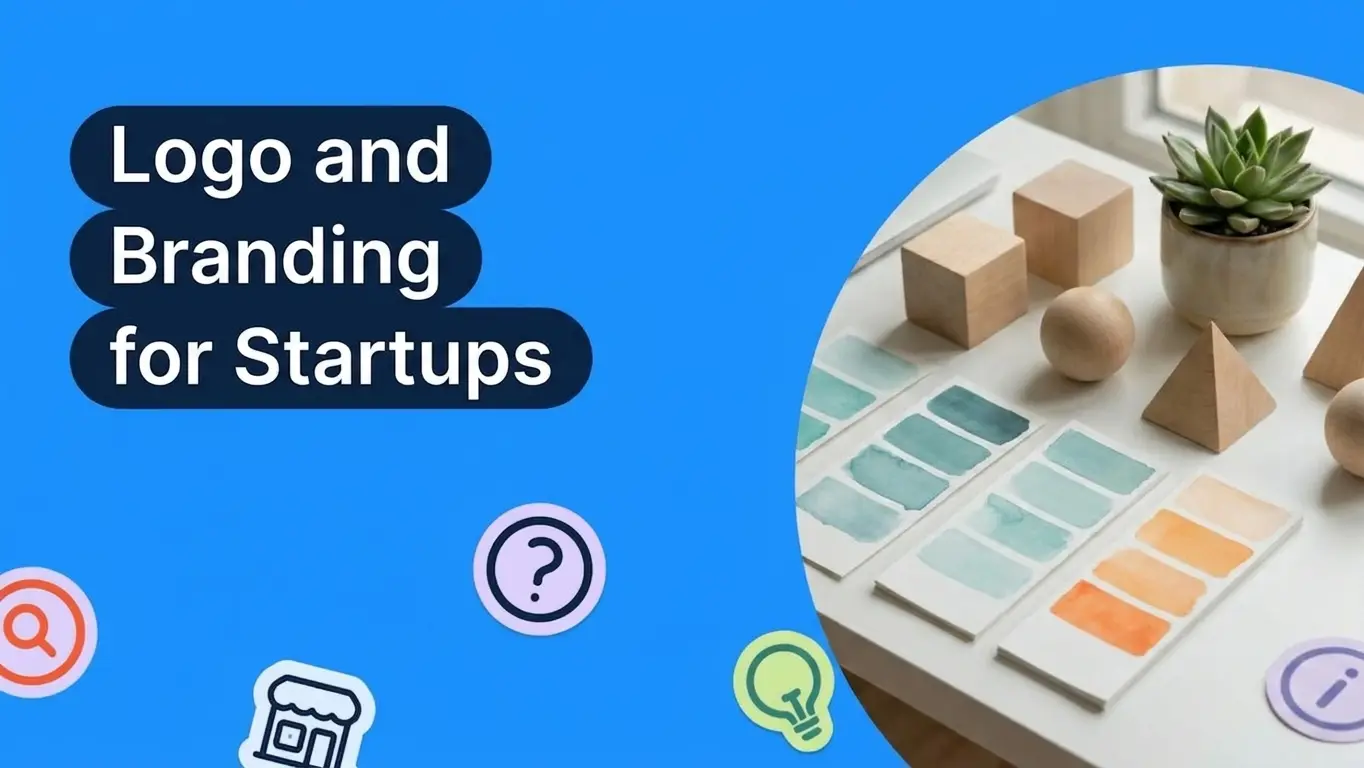
Most startups handle logo and branding in one of three ways. They use a logo maker like LOGO.com, hire a freelance designer through a platform such as Fiverr or 99designs, or work with a branding agency. The best fit depends on your stage, your budget, and how much creative direction you can give. Founders before product market fit usually start with a logo maker for speed and cost. Funded startups often hire a freelancer for more polish. Agencies suit teams that need a full brand system.
Why your startup needs a logo early
Your logo is the first visible signal that your startup is real. It shows up on your landing page, your pitch deck, your social profiles, your invoices, and the email footer of every founder note you send. Skip this step and every asset looks unfinished. Investors notice. Early customers notice. So do potential hires.
A logo also gives you a centre of gravity for the rest of your brand. Once you have one mark, you have colours, type, and a tone you can build around. Without it you keep restarting from scratch every time you make a deck or a tweet.
According to LOGO.com data, the top five industries among founders who upgrade to a paid Logo Pro or Brand Plan are technology, consulting, construction, fashion, and financial services. Those founders are putting real money behind their brand, not just clicking through a free logo maker. The list shows branding pays off well beyond the obvious creative industries.
There is also a cost benefit if you act early. Updating one decent logo across your site is straightforward. Replacing five inconsistent placeholder marks across a year of content is painful and slow.
The three main paths
There is no single correct answer for how startups handle this. There are three reasonable paths, and the right one depends on your stage, your budget, and how much creative direction you can offer.
The first path is a logo maker. You answer a few questions about your business, generate options, customise the one you like, and walk away with usable files inside an hour. You keep full ownership and you can return to edit any time.
The second path is a freelance designer. You write a brief, post it on Fiverr, 99designs, Upwork, or Dribbble, and pick someone whose portfolio matches your aesthetic. You then work together for a week or two on concepts, revisions, and final files. Costs range from around 50 dollars on the low end to several thousand on the high end depending on experience and scope.
The third path is a branding agency. You commission a full identity system that often includes strategy, naming, logo, typography, colour, and brand applications. Pricing starts around 5,000 dollars at small studios and scales into six figures for larger agencies. Timelines run four to twelve weeks.
Most startups use one or two of these. They start cheap, then upgrade when they raise or hit revenue.
Using a logo maker
A logo maker is the fastest path from idea to usable mark. You enter your business name, pick an industry, choose a few styles you like, and the tool generates concepts you can customise. Most founders walk out with a logo, a colour palette, and a font in under an hour.
The cost is the biggest selling point. A free or low cost logo maker fits the budget of any founder who has not yet raised. You skip the back and forth of briefing a designer, you do not pay for revisions, and you do not need to know any design jargon.
Modern logo makers like LOGO.com also produce more than just a logo. You get a brand kit with your colours, fonts, and exportable assets, plus social media graphics, business cards, and a one click website. That means your first 10 marketing assets share a consistent look without you ever opening Photoshop.
The trade off is creative ceiling. A logo maker is excellent for clean, contemporary, scalable marks. If you want something handmade, weird, or deeply conceptual, you may need a designer with their own taste to push past defaults.
For most early stage startups, that ceiling does not matter. You need a usable mark by Friday, not a thesis on visual identity. A logo maker delivers that.
If you want to test the cheapest path first, our free logo guide walks through the full process, from picking a name to exporting your final files.
Hiring a freelance designer
Freelancers sit in the middle of the spectrum. You get a real human with their own taste and a portfolio you can review before you hire. You also get back and forth on the brief, which often produces a better outcome than a tool can.
The trick is selection. Browse portfolios on Dribbble, Behance, 99designs, and Fiverr. Filter by aesthetic, not price. A 200 dollar designer with a portfolio you love is usually a better hire than a 1,500 dollar designer whose work feels off. Read recent reviews and look for designers who have shipped work in your sector.
Write a clear brief before you reach out. Cover what your business does, your target customer, three brands you admire, three you do not, any colours you must avoid, and where the logo will appear. Designers will quote faster and revise less when the brief is precise.
Expect three rounds of feedback as a baseline. Round one is concept directions. Round two is refinement on your favourite. Round three is final tweaks and file delivery. Anything beyond that usually signals a brief problem rather than a designer problem.
Cost ranges widely. On Fiverr you can find decent work between 50 and 300 dollars. Mid level freelancers run 500 to 2,000 dollars. Senior independent designers can charge 3,000 to 10,000 dollars for a logo and basic identity.
For most funded but early stage startups, somewhere between 500 and 1,500 dollars buys a logo that holds up for years. You also walk away with a designer relationship you can return to for future assets.
Working with a branding agency
A branding agency is the most expensive path and the most thorough. Instead of just a logo, you get a full identity system. That usually includes brand strategy, naming if you need it, logo, typography, colour palette, brand voice, photography direction, and applications across web, social, packaging, and merchandise.
The process is longer. Expect four to twelve weeks. The agency will run discovery interviews with you, your team, and sometimes your customers. They will research your competitors, write a positioning brief, then move into visual exploration. You usually get two or three concept routes, then refinement on the chosen direction, then a finished brand book.
Pricing starts around 5,000 dollars at small studios and runs from 25,000 to 250,000 dollars at larger ones. Founders raising a Series A often spend 15,000 to 50,000 dollars on their first proper rebrand because their original logo no longer fits the company they are building.
The upside is depth. A good agency forces you to articulate what your brand stands for, who it serves, and how it sounds. The output is not just visuals. It is a system any future hire can use without asking you what tone to write in.
The downside is time and cost. If you are still figuring out your product, you do not need a 50,000 dollar identity. You need to ship and learn. A founder who pays an agency before product market fit often pays again twelve months later when the company changes direction.
Use an agency once your business model is stable and you are about to scale.
How to choose the right path
Match the path to your stage and your budget. Here is a useful way to think about it.
If you have not raised money and you are still validating the idea, use a logo maker. Spend zero to 50 dollars. Get a clean mark, a colour palette, and a brand kit you can apply across your site, your deck, and your social profiles. Move on to building the product.
If you have raised a small angel round or you are generating revenue, hire a freelancer. Spend 500 to 2,000 dollars. You get a designer who can interpret a brief, push back on bad ideas, and produce something with more personality than a generated mark. Keep their contact for future work.
If you have raised a seed round or beyond and your product is in market, consider an agency. Spend 10,000 to 50,000 dollars on a real identity system. By this stage you know who your customer is and what your brand should stand for, so the strategy work pays off.
There is also a hybrid path that more founders are using. You start with a logo maker on day one to ship something usable, then hire a freelancer at month six to refine it, then engage an agency at month eighteen for a full identity. Each step builds on the last instead of throwing the previous work away.
The mistake is overspending early or underspending late. Match the path to where the business actually is, not where you hope it will be in two years.
Building a brand kit after the logo
A logo is only the start. The thing customers actually feel is the brand kit. That is the system of colours, fonts, photography, and tone that shows up everywhere you appear. Without one, your assets look slightly different on every channel. With one, your business looks bigger than it is.
Build five things into your brand kit from day one. The first is a primary and secondary colour palette with hex values. The second is a heading font and a body font, both available on Google Fonts so anyone on your team can use them. The third is your logo in three formats, the full mark, an icon only version, and a wordmark only version. The fourth is a tone of voice document with three or four words that describe how you sound, plus a few example sentences. The fifth is a small set of imagery rules covering photo style, illustration style, and what to avoid.
You can build a kit yourself in an afternoon, or you can have one generated automatically when you create your logo on LOGO.com. Either works. The point is to write it down. A brand kit that lives in someone's head dies the day you make your first hire.
Once you have a kit, audit your existing assets every quarter. Take your last five marketing pieces and check them against the kit. If three are off, the kit is being ignored and you need to share it more visibly inside the company.
What investors and customers actually notice
Founders often worry about the wrong details. They debate two shades of blue for an hour and skip the parts that actually shape how outsiders judge the brand. Here is what investors and customers genuinely register in the first 30 seconds.
The first thing they notice is consistency. If your landing page, your pitch deck, and your LinkedIn header use three different logos, your audience reads that as a small, unfocused team. The fix is not a better logo. It is using the same one everywhere. Pull every public asset into one folder and check that the mark, the colours, and the type are identical across all of them.
The second thing they notice is the gap between your brand and your category. A wellness app that looks like an enterprise SaaS company creates friction. A B2B tool that looks like a consumer game does the same. Your visual identity should match the expectations of your buyer, then add a small twist that makes you memorable. Without that fit, the rest of your messaging has to work harder.
The third thing they notice is the feel of your typography. Type does most of the silent communication. A serif feels editorial. A geometric sans feels modern. A condensed industrial face feels bold. Pick on purpose, then use it consistently across every surface. Customers cannot name what is off when type is wrong, but they sense it.
What they do not notice, generally, is whether your logo is bespoke or generated. They notice whether it works. A clean logo from a good logo maker beats a custom logo that does not scale. Worry about the right things in the right order.
Common branding mistakes startups make
The first mistake is overthinking the logo. Founders spend three months on a mark and zero days on positioning. The mark matters less than the message. A simple logo with a clear message beats a beautiful logo with no story.
The second mistake is copying a competitor. If your logo could be swapped with the brand you most admire and nobody would notice, you have not made anything. Pick a direction your competitors do not own.
The third mistake is too many colours. Three to five is plenty. Anything more becomes impossible to apply consistently across channels.
The fourth mistake is unscalable type. A heading font that looks good at 100 pixels often falls apart at 16 pixels on mobile. Test your fonts at the smallest size you will ever use them.
The fifth mistake is locking in too early. If you commission a 30,000 dollar identity in week one and pivot in month four, you wasted the money. Spend in proportion to your certainty.
The sixth mistake is forgetting trademarks. If you skip a trademark search and end up with a name another business already owns in your category, you may have to redo everything two years in. Do a basic search before you finalise the name and the mark.
The seventh mistake is treating the brand as the designer's job. The brand belongs to the founder. The designer renders it. If you outsource judgment, you get a mark that looks generic because nobody pushed past the defaults.
Frequently asked questions
Should I trademark my startup logo?
If you plan to operate the business for more than a year and you have a unique mark, yes. A trademark protects your visual identity inside your category and stops competitors from using a confusingly similar mark. The full process takes six to twelve months and costs between 250 and 1,500 dollars in the US depending on whether you file yourself or use an attorney. Run a clearance search before you commit, since trademarking a name another business already owns is the most common reason a brand has to be redone later.
How long does startup logo design take?
A logo maker takes around 30 to 60 minutes from start to finish. A freelance designer usually takes seven to fourteen days for a full project including revisions. A branding agency runs four to twelve weeks depending on scope. Founders who need something usable by Monday should pick a logo maker. Anything that takes longer than three weeks for a single mark usually means the brief was too vague.
How much should a startup spend on branding?
Spend in proportion to your stage. Pre seed and bootstrapped founders should spend zero to 200 dollars. Seed funded founders can stretch to 1,500 to 5,000 dollars on a freelancer. Series A and beyond can justify 15,000 to 50,000 dollars on an agency. Spending more does not produce a better outcome. It produces a more thorough one. The right answer is matching the spend to where the business actually is.
Can I redesign my logo later?
Yes, and most successful startups do. The average company refreshes its logo every five to seven years. A small refresh keeps colours and shape but cleans up the lines. A full rebrand changes the mark, the name, or both. Plan the redesign for a moment when you have new positioning to communicate, since a fresh logo without a fresh story rarely lands.
Do I need a logo before I have a product?
Yes, even if it is temporary. The moment you start emailing investors, customers, or hires, you need something on the bottom of the email. A simple wordmark from a logo maker is fine. The risk of having no logo is bigger than the risk of changing one later. Investors interpret the absence of a brand as a sign that the founder has not thought about the customer.
What file formats do I need from my logo?
You need at least three. SVG for the web, PNG with transparent background for digital assets, and a layered file like AI or PDF for print. Anyone who delivers a logo as only a JPG has not finished the job. Ask for the source file in your contract before work begins.
Build your startup brand with LOGO.com
If you want the fastest, cheapest path that still produces something professional, LOGO.com is built for you. You enter your business name, pick an industry, choose a few styles, and the tool generates dozens of concepts in seconds. You can customise colours, fonts, and layout, then export the files in every format you need.
The Brand Plan also gives you a full brand kit, a one click website, business cards, and over 1,000 marketing graphics, all using your finished logo. That means your first month of marketing assets matches your logo without you opening another design tool.
Most founders are exporting their first set of assets inside the hour. Pick the path that matches your stage, ship something usable this week, and let the brand grow with the business. If you want a custom icon, start with our AI logo maker.
Recent posts
Oct 19, 2026 by: Sean Baker
Oct 14, 2026 by: Vanessa Lam
Oct 12, 2026 by: Sean Baker
Oct 5, 2026 by: Sean Baker