How to Grow a Business Without Social Media
Yes, you can grow a business without social media. Here's how to use SEO, email, referrals, and partnerships to drive consistent sales.
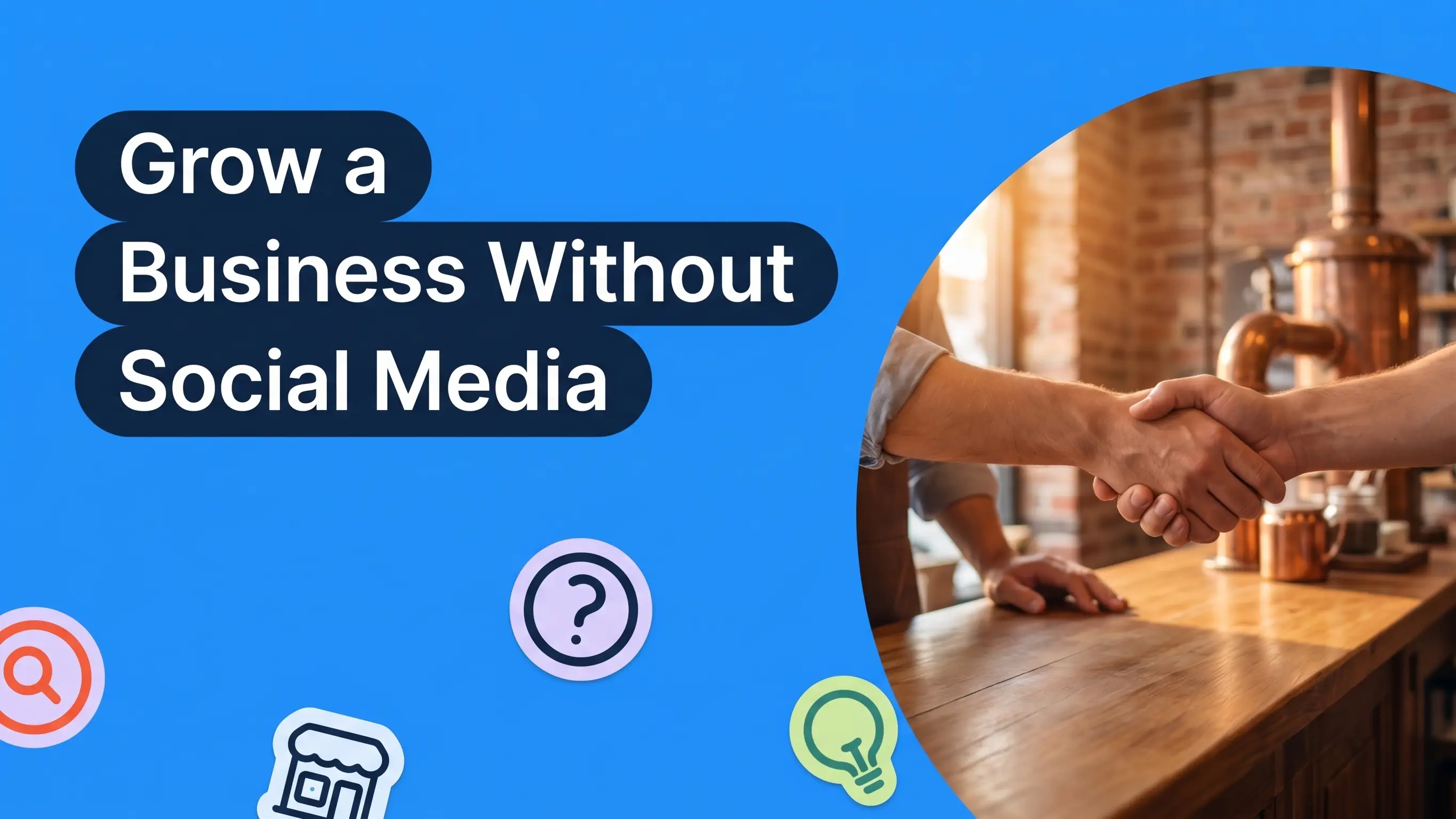
Yes, you can grow a business without social media. Plenty of profitable companies run almost entirely on search traffic, email lists, referrals, partnerships, and word of mouth. To make it work, you focus on three pillars. First, build a website that ranks for the exact phrases your buyers type into Google. Second, capture every visitor with an email list and warm them up with steady, useful messages. Third, treat existing customers as your marketing channel through reviews, referrals, and consistent follow up. Done well, those channels can outlast any algorithm and keep selling while you sleep.
Why You Can Grow Without Social Media
Most advice online assumes you need Instagram, TikTok, or LinkedIn to make sales. That advice fits large consumer brands and creator economies. It does not always fit a small business owner who already has a product, a few hundred returning customers, and steady monthly revenue. Many businesses that look quiet on social are pulling in six figures from organic search and repeat buyers.
If your monthly traffic comes mostly from Google, repeat customers, and direct visits, social media is a bonus, not your engine. The platforms borrow your attention every day and then change the rules every quarter. SEO, email, and referrals belong to you. The traffic compounds the more you invest, and the leads do not vanish when an algorithm shifts.
That does not mean social media is useless. It means you can choose to skip it without losing your business. The decision becomes a question of where your time pays the best return. If five hours a week on Instagram drives less revenue than five hours a week writing a single SEO article, the answer is clear. Time is your scarcest resource. Spend it on the channel with the highest return.
There is a quieter benefit too. Without daily content pressure, you focus on the product, the customer experience, and the things that compound. Customers who come from search and word of mouth tend to convert at a higher rate, return more often, and complain less. The lifetime value of a quiet customer often beats the lifetime value of a flashy follower. That alone can transform how your business feels to run.
Build a Website That Ranks
Search engine traffic is the most important channel to replace social media. People who type "men's silver chain" or "handmade leather wallet" into Google are already ready to buy. Your job is to make sure your store or service page is the result they click on.
Start with the words your buyers actually use. Open Google and type in the first few characters of your product. Look at the autocomplete suggestions. Open the "People also ask" box. Browse the related searches at the bottom of the results page. Write down every phrase that fits your offer. Those phrases are your starter keyword list.
Then build pages around those phrases, not around clever brand language. A page titled "Custom Engraved Silver Chains for Men" will outrank a page titled "Our Story" every single time. Each page should answer the searcher's question completely. Include sizing, materials, shipping times, care instructions, real photos, and answers to common objections.
Speed and structure matter. Make sure your product images are compressed, your headings follow a clean H1 then H2 hierarchy, and your URLs are short and readable. Internal links between related pages help Google understand your site. If you want a primer on the technical side, see our SEO basics for small business owners.
Backlinks still matter. A handful of quality mentions on real sites in your category will lift your rankings faster than any tweak you make on a single page. Reach out to small industry blogs, local newspapers, and complementary businesses with a useful pitch, not a generic ask. One thoughtful link from a relevant site beats 50 spammy ones.
Patience is the price of admission. New pages can take 60 to 120 days to rank. After that, carefully crafted pages bring in traffic for years with no extra spend. Treat each article and product page as an asset that pays you back every month forever.
Turn Every Visitor Into an Email Subscriber
If you skip social media, email becomes your most valuable owned channel. A typical small business email list converts five to 10 times better than an Instagram follower base, because subscribers asked to hear from you and chose to share a real address.
Give new visitors a clear reason to subscribe. A small discount on the first order, a free style guide, a short maintenance tutorial, or a simple comparison sheet all work. The reward needs to be relevant to the product. A 10 percent off coupon on a luxury jewellery store will outperform a generic "join our newsletter" form by a wide margin.
Once people subscribe, send them a welcome sequence of four or five short emails. Introduce yourself. Explain what makes your product different. Show how customers use it. Share one piece of social proof. End the sequence with an offer that has a clear deadline.
After that, a single broadcast every two weeks is usually enough. Share a story, a behind the scenes update, or a new product launch. Treat the inbox like a slow conversation, not a megaphone. For a deeper walkthrough, see our guide to email marketing on a small budget.
Watch three numbers every month. Open rate tells you whether your subject lines and reputation are healthy. Click rate tells you whether your content is interesting. Revenue per email tells you whether your offer is right. If any of those drops, fix the one number before you change anything else. Email is forgiving but only when you respond to the data.
Make Word of Mouth Your Second Channel
When social media is off the table, your existing customers become your biggest marketing asset. They already trust you. They already know what you sell. They talk to people who look exactly like them.
Build a simple referral loop. After a successful purchase, send a thank you email with a personal note and a clear ask. Offer 10 percent off the next order for the customer who refers a friend, and a small welcome discount for the friend who arrives. Tools like ReferralCandy or a simple coupon code system work fine for stores under $100,000 in revenue.
Ask for reviews on every order. A short follow up email seven days after delivery, with a single button to leave a review, can lift your review count significantly within a month. Reviews on Google Business, Trustpilot, or your product pages create social proof that does the persuading for you when a new buyer lands.
Make the request easy. Customers will write a review when you tell them exactly what to do. A short subject line, a single button, and a one sentence prompt like "What problem did this product solve for you" works far better than a generic "leave us a review" line. Include the review link in your packing slip and your order confirmation email too, so the ask shows up in three places without feeling pushy.
If you sell a physical product, drop a small handwritten thank you card in the box. The cost is pennies. The lift in repeat orders is real. It costs less than a single Instagram ad and lasts forever.
Partner With Other Small Businesses
Partnerships are the most underused growth lever for small businesses. You do not need a big audience yourself if you can borrow a few friendly ones from people who serve the same customer.
Look for businesses that target your buyer but do not compete with you. A men's jewellery brand could partner with a men's grooming brand, a tailoring service, or a barber shop. A wedding photographer could partner with a florist, a planner, and a venue. Reach out with a clear pitch. Offer something concrete like a 15 percent discount code their customers can use, a free product to give away in a draw, or a shared guide you both write together and promote to your lists.
Cross promotions move faster than SEO and cost less than ads. Most arrangements happen over a single email and one follow up. The trick is to bring a real benefit to the partner's audience, not a thin self promotion. Treat the partner the way you would treat a customer. Make their lives easier. Offer to do the heavy lifting on the creative, the copy, and the scheduling. Most small business owners are busy. They will say yes to a partner who removes work, not adds it.
Track every partnership the same way you track an ad. Tag the link with a unique UTM. Measure clicks, conversions, and revenue. If a partnership pays back in the first 30 days, repeat it next quarter. If it does not, ask what went wrong and try a new angle. Three good partners a year can replace a thousand Instagram followers.
Show Up in Local Search and Directories
If you sell to a specific area, local search can quietly replace a huge amount of social effort. Claim your Google Business profile. Fill in every field, add real photos, list your hours, and write a description packed with the words customers use to find you. Ask happy customers to leave Google reviews and respond to every one.
List your business on the major directories relevant to your category. For United States businesses, that means Yelp, Apple Maps, Bing Places, and any directory specific to your industry. The goal is to be the answer when someone types "men's jewellery near me" or "handmade silver chain in Atlanta".
Even online stores benefit from this work, because Google's local panel often appears for branded searches and adds another point of trust. A customer who types your brand name and sees a tidy local profile feels safer placing an order than one who sees nothing.
Add a single FAQ section to your homepage that answers the three or four questions buyers always ask before they purchase. Shipping times. Return policy. Sizing. Care instructions. Google often pulls those answers into the rich results panel, which gives you free extra real estate on the search page and lifts your rate of clicks.
Track What Actually Drives Sales
Without social media, you lose the comfort of seeing likes and follows tick up. You replace that with real numbers. Install a simple analytics setup that tells you where your sales come from, what keywords drive new traffic, and which emails make money.
Google Analytics and Google Search Console are free and enough for most small stores. Search Console shows you the exact queries that bring people to your site, the average ranking position, and how often searchers click. Those three numbers are gold. If a page ranks at position eight for a strong keyword, a small content update can lift it to position three and double the traffic. If you want the official walkthrough, see Google's search guidance on how the index works.
Tag every email link with UTM parameters. Use a basic dashboard or a spreadsheet to track weekly revenue by channel. The numbers do not need to be perfect. They need to be honest enough that you can decide where to put the next hour.
The simplest scoreboard has five rows. Direct traffic. Organic search. Email. Referrals from partners. Everything else. Each week you write the revenue from each. After eight weeks, the pattern is impossible to miss. You stop guessing and you start investing in the row that pays.
If a channel takes five hours a week and brings in three percent of sales, cut it. If a channel takes one hour a week and brings in 30 percent of sales, double it. That is the entire game. Most small business owners spend years chasing the wrong row because no one ever told them to write the scoreboard down.
When Social Media Is Still Worth Doing
There are a few scenarios where a light social presence still pays. If a large share of your buyers find you through Instagram or TikTok during the research phase, you want at least a clean profile that confirms you are a real business. If you sell visual products such as art, fashion, or food, a small Pinterest or Instagram presence can support your SEO by driving image search traffic. If you ever plan to apply for press features or brand partnerships, journalists and partner brands will look you up first.
The fix is to make the social profile a brochure, not a job. Post once or twice a month. Use the same product photos you already shoot for your website. Pin a "shop the site" link to the top. You give up the algorithm chase and keep the trust signal.
If you do choose to keep a profile, set a strict time budget. One hour every other week, scheduled. Anything more is a slow leak on your week. The point is presence, not performance. Anyone who lands on your profile should see a real business, real photos, and a clear way to buy. Vanity metrics no longer matter.
Some founders find that social returns once their business is established. A loyal email list and a steady SEO base often makes social posts perform better, because the audience already knows the brand. Treat the question as a season, not a forever decision. You can always come back when the time fits.
FAQ
Can a business really grow with no Instagram or TikTok?
Yes, and many do. SEO, email, partnerships, and referrals can carry a small business to six figures and beyond. Social media is one channel among several. If it drains your time and brings in less than 10 percent of sales, you can drop it without measurable harm. Watch your revenue by channel for a month after stepping back. The honest numbers will tell you if you can keep going.
How long does it take SEO to work for a new website?
Plan for three to six months before new pages start ranking, and 12 months before SEO becomes your largest source of traffic. The first 90 days are about publishing carefully structured pages around real buyer keywords. The next 90 days are about earning a few quality backlinks and refining the pages that show early promise. Be patient and consistent. Search rewards both.
What is the simplest email setup for a small business?
Pick one tool such as Klaviyo, Mailchimp, or Beehiiv. Add a popup or footer signup to your site with a clear offer. Build a welcome sequence of four to five emails. Send one broadcast every two weeks. That setup will outperform almost anything else you can do in your first year if you ship it consistently. Treat the list as your most important asset.
Do I need ads if I do not run social media?
Not necessarily. Many small businesses grow profitably without ads by focusing on SEO and referrals. Paid ads make sense once you know your average order value, your cost to acquire a customer, and your lifetime value with basic accuracy. If you do not know those numbers yet, spend your time fixing your website and email instead. Ads pour fuel on an existing engine. They cannot build one.
What if my competitors all have huge social followings?
Audience size on social rarely matches revenue. Plenty of brands with 100,000 followers struggle to clear five figures in monthly sales. Plenty of brands with 1,000 followers clear six figures because they have a strong product, sharp SEO, and a loyal email list. Compare yourself on revenue per customer and search rankings, not on follower count. Follower count is a vanity metric. Revenue is the only number that pays your bills.
Build a Brand Worth Searching For
If you choose to skip social media, your brand has to do more work in the places customers actually look. Your logo, your colours, your fonts, and the look of your site all need to feel sharp the moment a stranger lands on a Google result. A consistent brand is what turns a curious visitor into a buyer and a buyer into a returning customer.
LOGO.com helps you build that brand in minutes. Generate a custom logo, a full brand kit, business cards, a website, and matching social profiles all in one place. You can stay quiet on social if you want, while every other surface still looks like a real, trustworthy business. Pick a name, generate a logo, and your colours, fonts, and templates fall into place. Once your brand looks the part, your SEO, email, and referrals all carry more weight.
Start your free brand at LOGO.com today and let the rest of your channels do the work that social used to.
Recent posts
Oct 19, 2026 by: Sean Baker
Oct 14, 2026 by: Vanessa Lam
Oct 12, 2026 by: Sean Baker
Oct 5, 2026 by: Sean Baker