How to Get Local Clients for Your Service Business
Win local clients for your service business with seven proven tactics that work even without a paid ad budget.
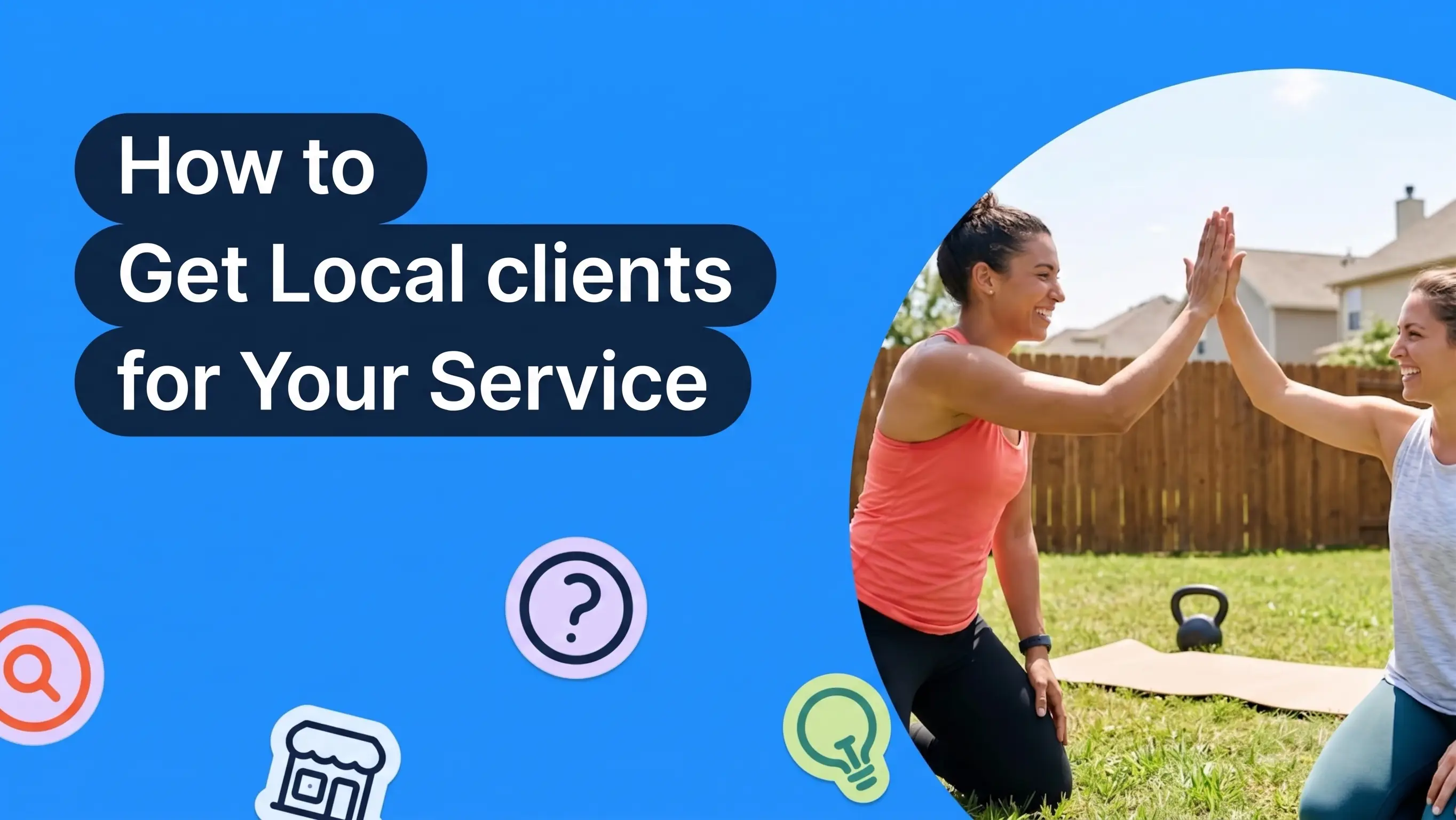
To get local clients for your service business, you need three things working together. Show up where nearby customers already search. Build social proof from people they trust. And make your first booking step almost effortless. Set up a Google Business Profile, claim free listings on Nextdoor and Yelp, ask happy customers for short written reviews, post consistently inside two or three local Facebook groups, and run a small flyer push inside your service radius. Then send every interested visitor straight to a calendar link.
Start with a fully optimized Google Business Profile
For local service work, your Google Business Profile is the closest thing to free billboard space in front of your exact buyer. When someone in your area types "personal trainer near me" or "house cleaner in [town]," Google ranks the local pack above almost every other result. A complete profile gives you a fighting chance of landing in that top three. If you want a deeper dive on the search side of the puzzle, our guide on local SEO walks you through the ranking signals that move you up the local pack.
Walk through the setup like this. Add your service area instead of a fixed address if you travel to clients. Pick the most specific business category Google offers. Upload at least ten real photos that show you working, not stock images. Write a description that runs around 750 words and mentions the services you offer and the neighborhoods you cover. Then add your hours, your phone number, and a direct link to your booking page. Google's own setup instructions walk you through the verification steps if you get stuck.
Once the profile is live, treat it like a feed. Post a weekly update about a recent job, a transformation, or a special offer. Google rewards activity, and customers reading the listing get a sense that you are an active, trustworthy operator. Aim for one Google review per week for your first three months. That ramp alone is enough to push most service businesses into the top five of their local pack.
The fastest path to reviews is a small text message you send the moment a job finishes. Something like "Thanks again for the trust today. If you have thirty seconds, I would love a quick Google review. Here is the link." Send it while you are still in the driveway or before you leave the park. Open rates on those messages are above ninety percent and most happy customers will leave a review within the hour. Two months of that habit will put your profile ahead of every competitor who is waiting for reviews to happen organically.
Pick two or three local hangouts and show up consistently
Most service businesses think they need to be on every platform. You do not. You need to be in two or three local rooms where your future clients already hang out, and you need to be useful there week after week.
Start with Nextdoor and the local "ask a neighbor" Facebook group for your area. Spend a week reading before you post a single thing. Notice the questions that come up over and over. For a personal trainer that might be "Anyone know a trainer who comes to your house?" For a cleaner it might be "Looking for a reliable cleaner who shows up on time." Those are the moments where one helpful comment can lead to a paying client.
Once you understand the room, post helpful answers a few times a week. Do not lead with a sales pitch. Share a quick tip from your trade, answer a recurring question, or point someone to a useful resource even if it is not yours. After a month of generosity, when someone asks for a recommendation in your category, the regulars start tagging you without you saying a word. That kind of organic recommendation converts ten times harder than any cold message.
Build a simple weekly cadence. Two helpful comments a week in each group. One short post a week that shares something useful, like a quick photo of a finished job, a tip your customers always ask about, or a behind the scenes glimpse of your work. That rhythm keeps you visible without turning the group into your billboard.
Skip the groups that fight you. Some local Facebook groups ban self promotion outright, even when a member directly asks for a recommendation. Other groups are run by moderators who quietly favour their own contacts. You will know within a week of reading whether a group rewards helpfulness or punishes it. Pour your effort into the rooms that reward it and leave the rest alone. Two great rooms beat eight mediocre ones every single week.
Build a referral loop with your first ten clients
Every local service business has the same growth path. Your first ten happy clients become your sales team if you give them a reason to talk. The mistake most new owners make is hoping that good work alone will get them referred. It usually will not. People are busy. You need to ask, and you need to make it dead simple to say yes.
After every job, send a short message that says thank you, asks for a short written review, and offers a referral reward. The reward does not need to be cash. A free session, a free deep clean, an upgrade on their next visit, or even a handwritten card with a small voucher works just as well. The goal is to make the person feel valued for connecting you with someone new, not bribed.
Keep a running list of who has referred whom. Send a thank you note the same day a referral books with you. That single gesture is the difference between an occasional referral and an ongoing pipeline. People love watching their introduction land well. They will keep doing it as long as they feel their generosity is noticed.
A small twist that works well is adding a one sentence line to your invoice or follow up email. Something like "If you know two friends who would love this, I would be grateful for an introduction. Anyone who books gets twenty percent off their first session, and you get one free." Direct, friendly, no awkward pitch energy. You will be surprised how many invoices come back with two names attached.
Run a tiny door hanger or flyer push inside your service radius
Door to door marketing still works for local service businesses because almost nobody is doing it anymore. While every other service pro is fighting for attention on Instagram, you can hand a printed offer to fifty real homes in an afternoon and stand out by being the only person in months who showed up at their door with something useful.
Keep the design simple. One bold headline that names the service and the town. One clear offer that lowers the risk of trying you, like a free first consultation or twenty percent off the first month. A QR code or short URL that leads straight to your booking page. Your name, your phone number, your face, and a single line of social proof.
Walk a tight radius. For a personal trainer that might be every house within two miles of the park you use for training. For a mobile detailer it might be every home in a single middle income neighborhood. Track which streets the bookings come from so your next pass goes deeper in the areas that are working and skips the ones that are not. Expect a one to three percent response rate. That is enough to fill your week if you walk a thousand doors.
The flyers themselves do not need to be expensive. A run of five hundred glossy flyers from a print shop is usually under fifty dollars. The cost is your time. Block four afternoons on your calendar, pick four neighborhoods, and treat it as a focused two week sprint. Once you find the neighborhood that converts, you can revisit it twice a year and keep the pipeline warm.
Borrow trust with local partnerships
The fastest way to get in front of qualified local buyers is to stand next to someone they already trust. Map out the businesses that serve the same customer at a different moment of their day. A personal trainer should be best friends with the local physio, the chiropractor, the smoothie shop, and the running club. A mobile dog groomer should know every vet, dog walker, and pet supply store within ten miles.
Reach out with a real offer, not a vague request to promote each other. Offer to give every one of their customers a free first session, a discounted package, or a small added perk in exchange for a stack of cards at their counter. Even better, run a joint event. A free fitness class at the smoothie shop. A "meet your local pros" Saturday morning at the vet. Two businesses splitting the same hour of foot traffic costs each of you less and pulls more people than either could alone.
Treat these partnerships like real relationships. Send a thank you whenever they send you a customer, drop in once a month, and look for ways to send them business in return. The owners who succeed with local partnerships do not run them like a transaction. They run them like a small network of friends that all happen to make money together.
Pop up events are a fast way to test which partnerships actually fit your customer. Spending a Saturday morning behind a small table at a partner's location will teach you more about your local market in four hours than two weeks of guessing.
When you find one partnership that produces consistently, double down. Offer them a slightly better deal for their loyalty, send extra business their way, and ask if there is anything you could co create together. The owners who build a real local moat usually have two or three deep partnerships that quietly send them clients every week, not a long list of shallow ones that never amount to much.
Make your brand instantly recognizable on the street
When people see your van, your uniform, your social posts, and your business card all in the same week, you want them to register every touch point as the same business. That is what visual consistency does. It turns three forgettable impressions into one memorable brand.
For a service business, that means picking a clear color, a clean logo, a font, and one or two design elements, then putting them on absolutely everything. Your van wrap, your shirt, your invoices, your social profile, your flyer, your door hanger. The fastest way to do this is to build a simple brand kit and reuse it everywhere. If you do not have one yet, the LOGO.com brand kit generator creates a coordinated logo, color palette, and font set in a few minutes, and you can pull all of it into print and digital files without hiring a designer.
The compounding effect of visual consistency is hard to see in the first month and impossible to miss after six. People start saying "I see your van everywhere." That is not because you suddenly bought more vans. It is because every van they have already seen finally clicks together in their head as the same business.
This matters even more for service businesses, where you rarely get the chance to repeat your name in person. The visual cues do that repeating for you. A consistent color on every flyer, every invoice, and every Instagram post makes you feel three times bigger than you actually are, which is exactly the impression you want a new local lead to walk away with.
Track which channel actually brings paying clients
Most local service owners spread themselves too thin because they do not know what is actually working. The simplest fix is to ask every new client one question on their first visit or first call. "Where did you hear about us?" Write the answer down in your notes app or a single spreadsheet. After thirty bookings, the pattern will be obvious.
You will almost always find that two channels are doing seventy percent of the work and the rest are noise. Maybe your Google Business Profile and one local Facebook group are bringing every new client. Maybe it is referrals from one neighbor and the flyer push you did in March. Once you see the pattern, double the time you spend on the winners and quietly drop the rest.
This single discipline separates owners who plateau from owners who scale. The ones who plateau keep posting on every platform out of guilt. The ones who scale notice that ninety percent of their revenue came from three sources and pour their attention there.
Review your channel breakdown once a month with a quick coffee in your calendar. Five minutes is all it takes. Look at where your last twenty clients came from, compare it to the last twenty from the month before, and decide where you will spend your weekday morning marketing hour for the next four weeks. That kind of light review beats any complicated analytics tool for a one person service business.
If you have the energy to layer one more habit on top, start tracking lifetime value too. Some channels bring clients who book once and disappear. Others bring clients who stay with you for years and refer friends. Knowing which is which changes everything about where you invest your time. A flyer push that brings five clients who each spend two thousand dollars over a year is ten times more valuable than a viral post that brings fifty curious one timers.
Frequently asked questions
How long does it take to get steady local clients?
Most service businesses see a handful of paying clients within the first four to six weeks if they execute on the basics. A complete Google Business Profile, a steady presence in one or two local groups, and a referral ask after every job. The pipeline gets predictable around month three or four, once your first ten happy clients have referred two or three people each and your reviews start ranking you above competitors.
Should I pay for ads as a brand new local service business?
Not yet. Spend your first ninety days on the free options that compound. Google Business Profile, Nextdoor, local Facebook groups, referrals, and one targeted flyer push. Paid ads work, but they punish you for not knowing your offer, your audience, and your conversion rate. Earn those answers from organic effort first. Then layer paid ads on top of the channel you already know converts.
How do I price my services as a new local pro?
Price slightly under the most established local competitor for your first ten clients while you build reviews, then move to the local average once you have ten written reviews. Underpricing for too long signals low quality. Charging top dollar with no proof is a hard sell. The middle of your market with strong social proof is the sweet spot.
What do I do if I am the only person in my area in my niche?
Lean into it. Being the only local option in your category is a marketing gift. Lead every piece of content with "the only mobile cat groomer in [town]" or "the only personal trainer who trains at [specific park]." Specificity beats generic every time, and a clear niche makes word of mouth easy because people remember exactly who to mention.
How many social media platforms do I really need?
One or two. Pick the one your future clients use most and post twice a week with photos of real jobs, real clients, and real results. For most local service businesses that is Instagram or Facebook. TikTok is worth a try if your service is visual and your audience skews under thirty. Spreading across five platforms with thin content always loses to one platform with consistent presence.
How do I handle a slow first month without losing motivation?
Build a daily rhythm of three small actions. Post once in a local group, reach out to one potential referral partner, and ask one past client for a review. Three actions a day add up to roughly ninety touches in your first month. Something always converts from ninety touches. The owners who burn out are the ones waiting for one big breakthrough. The owners who win are the ones doing three small things a day until the breakthroughs compound.
Build a brand local clients remember
Local marketing rewards owners who show up consistently in a few visible places and back that visibility with a recognizable look. Once your Google Business Profile, referral loop, and partnerships are working together, the only ceiling left is how memorable your brand feels on the street.
If you have not nailed your visual identity yet, start there. A coordinated logo, color palette, and brand kit makes every van, shirt, invoice, flyer, and social post register as the same business in your customers' minds. LOGO.com builds a complete brand kit in a few minutes and gives you everything you need to print, post, and hand out without paying a designer. Generate yours, lock in the look, and let consistency do the quiet compounding work while you focus on serving the next client.
Recent posts
Oct 19, 2026 by: Sean Baker
Oct 14, 2026 by: Vanessa Lam
Oct 12, 2026 by: Sean Baker
Oct 5, 2026 by: Sean Baker