Personal vs. Business Instagram: Which Account Should Solo Business Owners Use?
Should solo business owners run a personal and a business Instagram, or just one? Here is a clear answer, plus how to set up your profile to attract clients and grow.
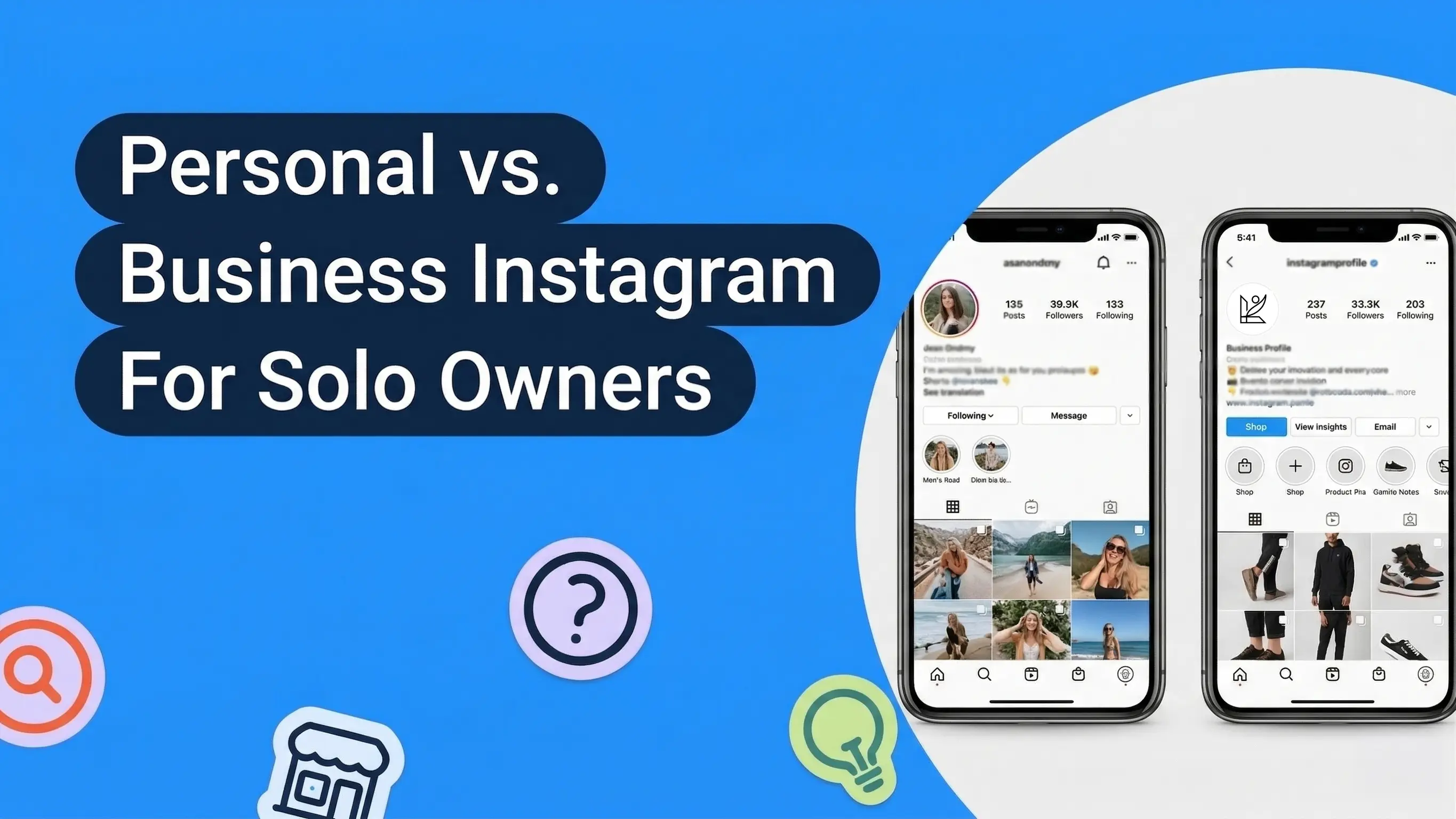
For most solo business owners, the answer is to use one account and make it your business profile. Running two active, polished Instagram accounts is unsustainable without a team behind you, and it splits the audience you are trying to build. Your business account should hold your portfolio, your behind the scenes content, your personality, and your process. That combination is what attracts both clients and brand deals. Your personal account can stay private or go dormant. One strong profile beats two weak ones every time.
Why Solo Business Owners Keep Getting This Wrong
It is a question that comes up constantly in communities for freelancers, photographers, designers, coaches, and anyone building a service-based business on their own. Should the business stay on its own page, with clean portfolio work and a professional bio? Or does all the personality content belong on the personal account where people already follow you?
The instinct to keep them separate makes sense on the surface. It feels tidy. Your business account is polished and curated. Your personal account is where you are actually yourself. But in practice, this split creates a problem: you end up maintaining two accounts, neither of which gets the consistency it needs to grow.
The other issue is that for solo business owners, you are the brand. Your personality, your taste, your process, the way you think about your work: these are not separate from your business. They are the reason people hire you over someone else with similar skills. When that content lives on a private personal account that potential clients never see, you are hiding the most compelling part of your offer.
What Actually Changes When You Switch to a Business Account
Before deciding which account to use, it helps to understand what a business account actually gives you that a personal one does not.
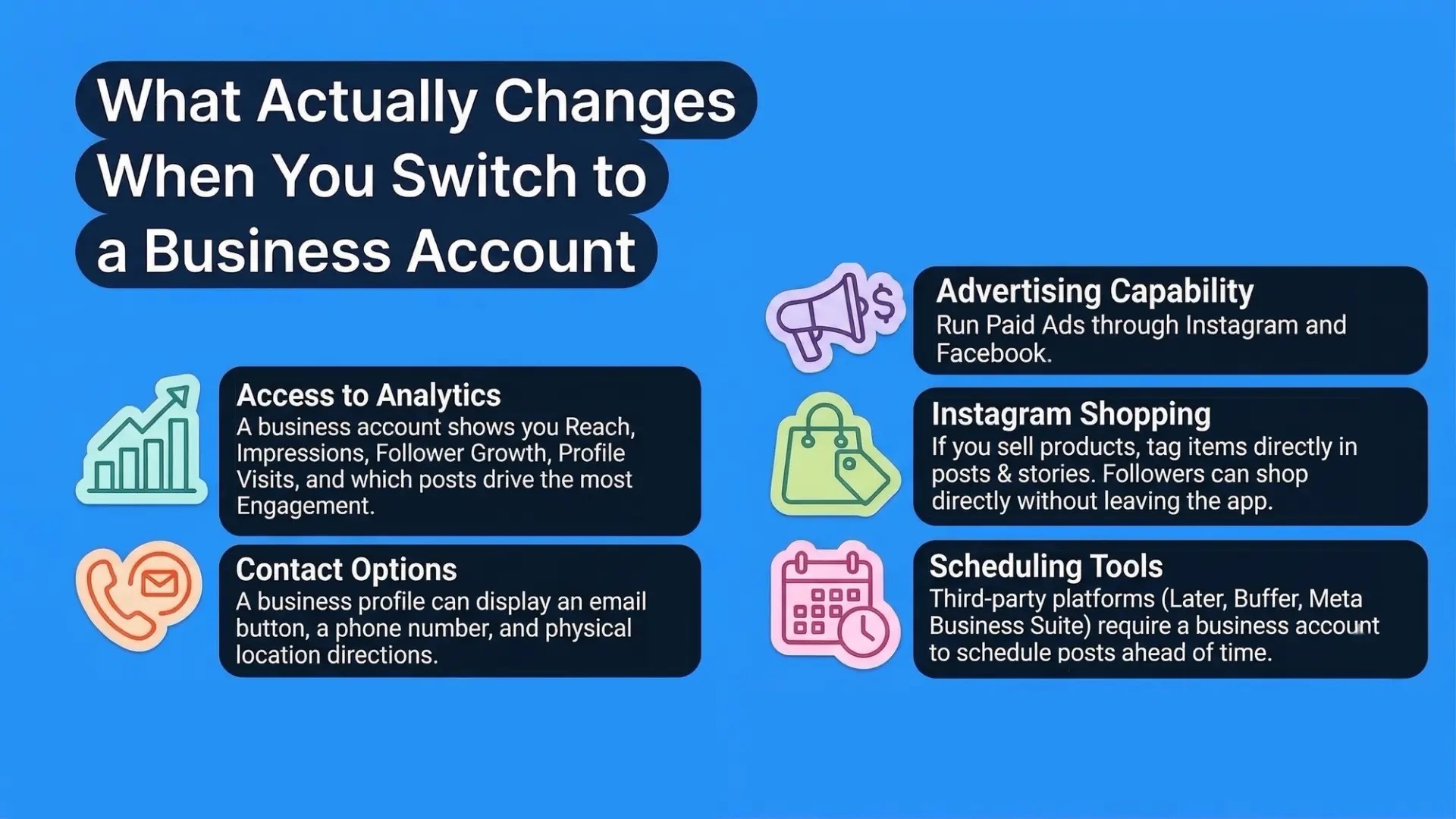
Access to analytics. A business account shows you reach, impressions, follower growth, profile visits, and which posts drive the most engagement. Without this data, you are posting with no clear picture of what is working.
Contact options. A business profile can display an email button, a phone number, and directions if you have a physical location. This makes it far easier for potential clients to reach you without hunting through your captions for the information.
Advertising capability. Only business and creator accounts can run paid ads through Instagram and Facebook. If you ever want to boost a post or run a targeted campaign, a business account is a requirement.
Instagram Shopping. If you sell products, a business account lets you tag items directly in posts and stories so followers can shop without leaving the app.
Scheduling tools. Third-party platforms like Later, Buffer, and Meta Business Suite require a business account to schedule posts ahead of time. If you want to plan and batch your content, this matters.
The switch from personal to business takes about sixty seconds in your settings. Your existing followers, posts, and username stay exactly the same. You can switch back at any time.
When Running Two Accounts Actually Makes Sense
There are situations where maintaining both a personal and a business account is the right call. But they are more specific than most people assume.
Your personal following is already large and relevant. If you have built thousands of followers on your personal account who match your target client, walking away from that audience is a real cost. In this situation, it may be worth maintaining both while gradually shifting your business content onto the professional profile and letting the personal account wind down naturally.
Your personal brand is the product. If you are a content creator or someone whose audience follows you specifically as a person rather than a business, your personal account effectively is your business. The right move here is to switch that account to a creator or business profile rather than creating a second one.
You genuinely need privacy. If you share personal content that you would not want a client or a brand partner to see, keeping that account private makes sense. A private account is not the same as a second active business account. The goal is one strong public profile, not two.
Outside of these three scenarios, running two accounts actively is almost always the wrong call for a solo operator. Pick one. Build it properly.
How to Make Your Business Instagram Feel Personal
The reason many solo business owners resist mixing personal content with their business account is that they are picturing two extremes: a perfectly curated portfolio with no warmth on one end, and an unfiltered personal account on the other. The space between those two is where the best business accounts live.
The goal is a business account that shows the person behind the work. Here is how to get there.
Show your face. Instagram's algorithm favors content featuring faces, and more importantly, clients hire people they trust. Trust starts with familiarity, and familiarity comes from seeing someone regularly. Showing up on your feed and in your stories as a real person accelerates that faster than any portfolio image can.
Document your process. The steps between receiving a brief and delivering a final product are genuinely interesting to the people who want to hire you. Share a mood board in progress, a color palette you are working through, or a photo of your workspace on a full shoot day. This content does not need to be polished. It needs to be real.
Use stories for the unpolished moments. Stories disappear after twenty four hours, which makes them lower stakes than your grid. This is where you can share things that would feel out of place as a permanent post: a studio visit, a question you are sitting with, a tool you have been relying on, or what a normal Tuesday actually looks like for you.
Let your opinions show. Share what draws you to a project. Talk about what good work means to you. Disagree with a trend if you genuinely disagree with it. Having a clear point of view is not unprofessional. It is what makes potential clients choose you specifically rather than someone else with a comparable portfolio.
Stay visually consistent. The personal content can be real and human without being visually chaotic. Using the same color palette, the same fonts on any branded graphics, and a consistent editing style across your posts creates an account that feels cohesive even when the subject matter varies.
What to Post on Your Business Account Without It Feeling Like a Billboard
One of the biggest concerns solo business owners have about posting personal content on a business account is that it will look unfocused. The fix is a clear content mix, not random posting. A reliable framework is to think in thirds.
One third of your posts should showcase your work. Finished client projects, polished deliverables, before and after comparisons, testimonials presented as graphics. This is the proof of what you do.
One third should show your process and your thinking. Behind the scenes content, work in progress, tools you rely on, decisions you are making, things you are learning. This is the proof of how you do it and what it actually feels like to work with you.
One third should be educational or conversational. Tips relevant to your ideal client, questions that invite comments, takes on topics in your industry, or content that helps the person you want to work with solve a problem they already have. This is the proof that you understand their world.
Within this mix, moments of personality show up naturally. When your day to day work is genuinely part of what you share, the person behind the business comes through without being forced.
How to Set Up Your Business Profile for Maximum Impact
Your profile is often the most neglected part of an Instagram account. Most people spend more time thinking about what to post than how the profile reads to someone who has never seen it before. A first time visitor has about three seconds to answer two questions: what does this person do, and is this worth following?
Profile Photo: Face or Logo?
For a solo business owner, your face is almost always more effective than your logo. People follow people. A logo works when your business has a team behind it or when your brand recognition is already strong enough that the logo carries real meaning on its own. For most solo operators, your face is more magnetic. Your logo can appear consistently across your content and highlight covers without needing to be the profile image itself.
Writing a Bio That Actually Works
One hundred and fifty characters is not a lot of space. Use them to answer three things: what you do, who you do it for, and what they should do next. Skip vague descriptors like creative or passionate without any specific context. Be direct. If you are a brand photographer for independent food businesses in Chicago, say exactly that.
Making the Most of Your Link in Bio
Instagram gives you one clickable link. A dedicated link in bio page is almost always more useful than sending people to a single URL. A well set up link in bio page can direct visitors to your portfolio, your inquiry form, your latest offer, and your other platforms all at once. LOGO.com's link in bio tool makes this easy to set up and keeps it looking consistent with the rest of your brand.
Setting Up Highlights That Do the Work for You
Organize your story highlights so that a new visitor can quickly understand what you offer, see examples of your work, read client testimonials, and find out how to hire you. Label them clearly and use branded cover images so the highlight row looks intentional rather than like a row of random screenshots.
How Consistent Branding Makes Your Account Work Harder
The visual consistency of your Instagram account is not just an aesthetic preference. It is a strategic one. When your account looks cohesive, people are more likely to follow, more likely to save your posts, and more likely to recommend your account to others because it is simply easier to describe what you do.
A brand kit gives you a defined set of colors, fonts, and logo variations you can pull from every time you create anything for your business, whether that is an Instagram graphic, a client proposal, a website header, or a business card. When the branding on your Instagram grid matches the branding on your website and your email signature, your business starts to feel more established than it may actually be at this stage.
That gap between how you perceive your own business and how potential clients perceive it is exactly what consistent visual identity closes. LOGO.com's brand kit keeps all of your brand assets in one place so you are not hunting through old files or guessing at hex codes every time you open a design tool.
How to Attract Brand Deals as a Solo Business Owner on Instagram
If attracting paid brand collaborations is part of the goal for your account, the question of one account versus two becomes even more important. Brands look at a few specific things before reaching out.
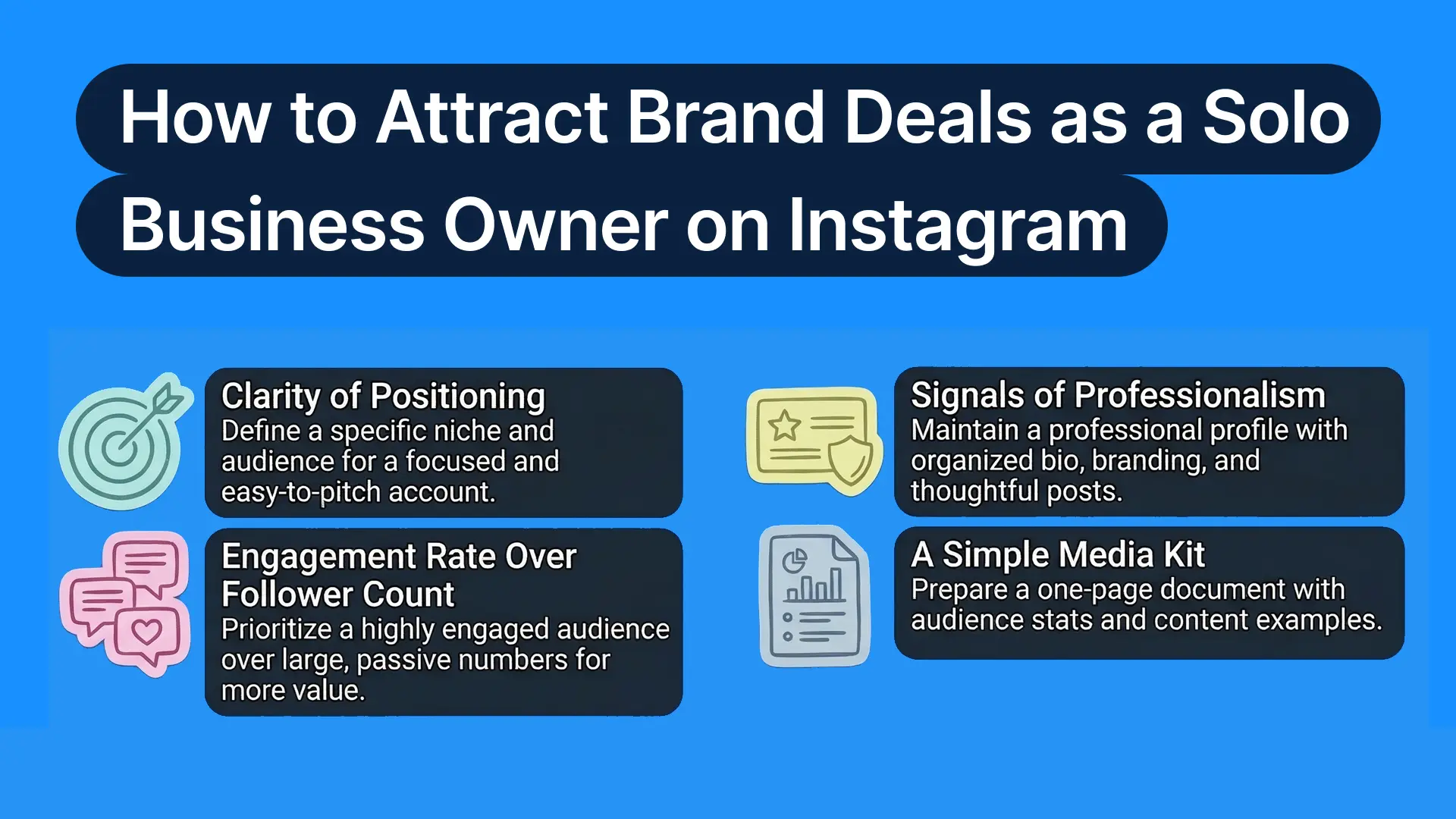
Clarity of positioning. A brand wants to know exactly who your audience is and what your account is about before they invest in working with you. A focused account with a clear niche and a consistent posting style is easy for a brand's marketing team to say yes to. A mixed account is much harder to pitch internally.
Engagement rate over follower count. For most brand collaborations at the small business scale, a highly engaged audience of five thousand followers is more valuable than a passive audience of fifty thousand. Brands track how many people comment, save, and share your content relative to how many people see it. Focus on building genuine engagement rather than chasing numbers.
Signals of professionalism. When a brand lands on your profile, they are looking for confirmation that you take your work seriously. A well organized profile, consistent branding, a clear bio, and posts that are thoughtfully put together all send that signal before you have said a word.
A simple media kit. Once your account starts gaining traction, having a one page document ready with your audience demographics, your average engagement rate, the types of content you create, and examples of any previous partnerships makes it easy to respond quickly when a brand reaches out. You do not need tens of thousands of followers to prepare this.
Common Questions About Personal vs. Business Instagram
Should my profile photo be my face or my logo?
For solo business owners, your face is almost always the better choice. People connect with people, and a face in the profile photo increases the chance that someone will follow you when they discover your account for the first time. Your logo can appear consistently in your branded graphics and as your highlight covers to keep your visual identity present without replacing your face as the main image.
Can I switch my personal account to a business account without losing my followers?
Yes, completely. Switching from a personal to a business or creator account does not affect your existing followers, your posts, your username, or your archive. It simply unlocks additional features including analytics, contact options, and advertising capability. You can switch back to a personal account at any time if you change your mind.
Do I need a business account to run Instagram ads?
Yes. Running paid ads on Instagram requires either a business or a creator account connected to a Facebook page. If paid promotion is any part of your growth plan, even occasionally, making the switch now means you will be ready when you need it without any disruption.
What if most of my following is already on my personal account?
This depends on how large that following is and how relevant they are to your business. If your personal account has a meaningful audience of people who could realistically become clients or refer clients to you, consider switching that account to a business or creator profile rather than starting a new one from scratch. You can update the username, bio, and content direction to better reflect your business without losing what you have already built.
How often should I post to grow my business account?
Consistency matters far more than volume. Three well-considered posts per week will outperform seven rushed ones every time. Decide on a frequency you can genuinely maintain for at least three months, and stick to it. The compound effect of showing up regularly is what builds an audience over time, not the total number of posts you publish.
Your Business Account Should Feel Like You
The goal of your Instagram presence is not to perform professionalism. It is to show the right people who you are, what you do, and why that makes you the person they should work with. A business account that combines your personality, your process, and your polished work does all three things at once.
You do not need two accounts to achieve that. You need one account that you actually invest in.
Start with a clean profile, a clear bio, and a content plan you can stick to. Add a link in bio page that sends people somewhere useful. Make sure your branding is consistent across everything a potential client might see. Then show up, regularly, as the person behind the work.
Ready to make your brand look as intentional as your work? Build your brand kit with LOGO.com and keep everything consistent from your Instagram grid to your client proposals.
Recent posts
Oct 19, 2026 by: Sean Baker
Oct 14, 2026 by: Vanessa Lam
Oct 12, 2026 by: Sean Baker
Oct 5, 2026 by: Sean Baker