Business Cards in 2026: Still Worth It or Totally Outdated?
Business cards are not dead, but the rules have changed. This guide explains when physical cards still make sense, how to design one that actually gets kept, and which digital alternatives work best for solo business owners and freelancers in 2026.
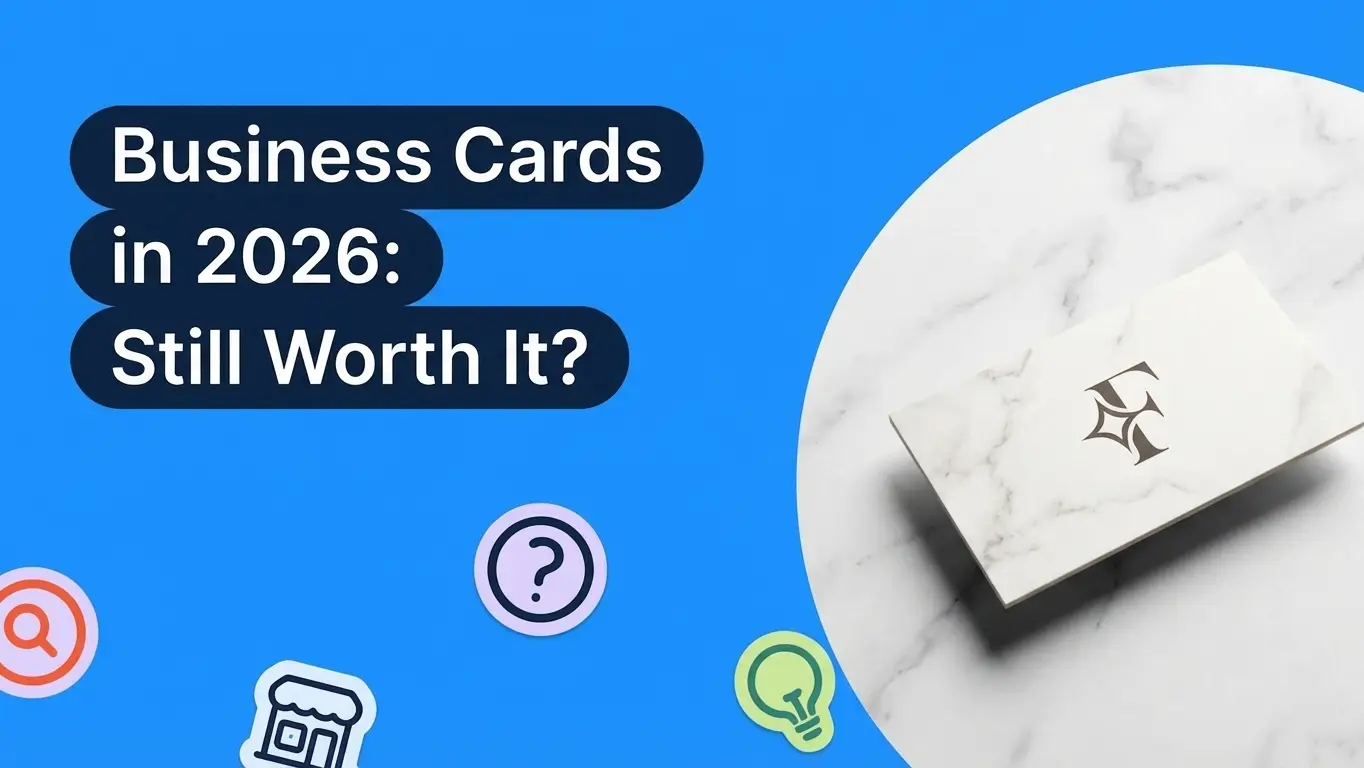
Business cards are not dead, but they have changed. Physical cards still work at networking events, client meetings, and local business interactions where a personal touchpoint matters. But you need a well designed card that reflects your brand identity. Generic cards with nothing memorable about them will end up in the trash. This guide covers when physical cards still make sense, how to design a card people actually keep, and which digital alternatives work best.
Why Business Cards Still Work in 2026
You might assume that business cards died when smartphones became ubiquitous. That's a reasonable assumption. After all, you can exchange contact information instantly through a dozen different apps, share your LinkedIn profile with a QR code, or add someone to your email list in seconds. So why do business cards still matter?
The answer comes down to something that technology has never quite replicated: the tactile, memorable nature of a physical object combined with a personal interaction. When you hand someone a business card, something different happens in their brain than when you say "find me on LinkedIn." They hold something tangible. They see your name, your brand, your design choices all at once. That moment of exchange creates a micro memory.
Business cards work because they feel intentional. In a world where we're all drowning in digital noise, a well designed business card stands out precisely because it's physical. It requires you to think about what you're putting into someone's hand. That's a good thing.
The data backs this up. Multiple surveys from 2024 and 2025 show that business professionals still exchange cards regularly, and the vast majority of recipients keep cards from people they want to stay connected with. The key word there is keep. Your card needs to be worth keeping.
There's also something psychologically real happening when you exchange cards in person. The person feels acknowledged. They have permission to reach out to you later. The card removes friction from follow up communication. Instead of fumbling for their phone and searching for your name on LinkedIn, they already have your number right there in their hand.
Plus, business cards serve as a physical representation of your brand. When someone pulls out a sharp, well designed card, it communicates that you care about quality and attention to detail. A sloppy or generic card does the opposite. Your business card tells a micro story about who you are and what you stand for before you even open your mouth.
When You Should Still Hand Out a Business Card
Not every situation calls for a business card. Understanding when to use them is crucial if you want them to actually work for you.
Networking events and conferences remain the prime hunting ground for business cards. When you're in a room with 100 other professionals looking to make connections, cards create a concrete exchange point. They give both people a reason to remember each other. You hand over the card, maybe you have a 30 second conversation, and that person knows exactly how to find you later. No guessing, no fuzzy memory.
Client meetings and service based businesses benefit hugely from cards. If you're a consultant, designer, accountant, or marketing professional meeting with potential clients, a card tells that person you're legitimate and established. It gives them an easy way to reference your contact information later and share it with colleagues who might need your services.
Local business interactions are another sweet spot. If you own a restaurant, salon, gym, or any brick and mortar business, business cards behind the counter or in your pocket create an easy way for people to remember you and recommend you to others. Local communities still rely heavily on word of mouth, and business cards facilitate that.
Speaking engagements, panel discussions, and any public appearance where you're representing yourself or your company warrant business cards. People who are impressed by what you say want an easy way to follow up with you.
Job interviews and career transitions benefit from having a few professional cards. Even though most hiring happens digitally now, pulling out a business card at the right moment in an interview makes you memorable and shows you take professionalism seriously.
Real estate agents, sales professionals, and anyone in a field where they meet clients face to face absolutely need cards. These industries still run on personal relationships and referrals. Cards are just part of the game.
And finally, if you're positioned as an industry expert, speaker, or thought leader, people will expect to get a card from you. It's part of the brand promise.
When a Digital Alternative Makes More Sense
Not every professional needs a business card anymore. If you work in certain fields or have a specific business model, a digital alternative might serve you better.
If your business is entirely online and you rarely meet clients face to face, a digital business card is probably sufficient. Most of your networking happens on social media, through email, or at virtual conferences anyway. Skip the physical card and focus on making your digital profiles strong.
If you're in a strictly B2B SaaS environment where networking happens almost exclusively online, business cards are probably unnecessary. Your LinkedIn profile is your business card. Your GitHub profile, your company website, or your email signature do the heavy lifting.
Freelancers and contractors who find work entirely through their website or portfolio might not benefit much from carrying business cards everywhere. You're already directing people to your digital work samples, so a card doesn't add much value.
If your budget is extremely tight and you're choosing between a business card and updating your website, choose the website. Your online presence matters more than a printed card in almost every circumstance.
And honestly, if you're not in situations where you meet people face to face regularly, business cards might just be clutter in your desk drawer. Be honest with yourself about your actual use case. Not every business model demands them.
How to Design a Business Card People Actually Keep
This is where most people go wrong. They design a business card that communicates all the information but none of the personality. A forgettable card is worse than no card at all because it takes up space in someone's wallet and then gets tossed when they clean up.
Start with your brand identity. Your business card should feel like a condensed version of your brand. If your brand is playful and colorful, your card should reflect that. If your brand is minimal and sophisticated, your card should communicate that immediately. When someone gets your card, they should feel like it matches the person they just met.
Choose one or two standout colors that represent your brand. Don't use every color in the rainbow. Restraint in color choice makes your card feel intentional and premium. A card with four different colors looks like you couldn't make a decision. A card with a thoughtful color choice looks like you knew exactly what you were doing.
Typography matters enormously. Choose a clean, readable font for your core information. You can have fun with a secondary font for your name or title, but readability always wins. No one keeps a business card they can't actually read.
Whitespace is your friend. Many people try to cram too much information into a business card. Leave room to breathe. Whitespace makes your card look premium and intentional. It also makes the information you do include stand out more.
Include essential information only. Your name, your title, your phone number, your email, and your website. That's usually it. You don't need to include your full address, your fax number, or your LinkedIn profile URL. Keep it simple. If people want to find you on LinkedIn, they will.
Consider adding a subtle visual element that represents your business. This could be an icon, a small illustration, or a pattern. It should be subtle enough not to overpower the text but distinctive enough to make your card memorable. This is where you show personality.
Use quality materials. A thick, heavy cardstock feels better in someone's hand than thin, flimsy cardboard. People notice quality. When someone gets a well made card, it tells them you care about quality in your business too.
Consider finishing touches like rounded corners, embossing, or a unique shape that still fits standard wallets. These details make people remember your card. But only add them if they serve your brand. Unnecessary gimmicks make you look like you're trying too hard.
Make sure the back of the card doesn't just sit empty. Use it for secondary information, a brand pattern, your social media handles, or a tagline. You paid for two sides, use them both.
Keep your design digital so you can update it easily. Your information might change. You might want to test different designs. Having an editable version means you can iterate without reprinting thousands of cards.
Business Card Design Mistakes That Kill Your First Impression
You can get so much right about your business and then blow it all with a business card that looks like it came from 2006. Here are the mistakes that make people trash your card immediately.
Outdated design is the biggest culprit. If your card design feels like it belongs to a different era, it makes your entire business feel outdated. This includes stock photos that look generic and cheap, fonts that scream "early 2000s," and color combinations that belong in a time capsule. If you're not sure if your design looks dated, ask someone in the creative industry. They can tell you immediately.
Unclear hierarchy is another killer. When someone gets your card, they should immediately know what to focus on. Usually that's your name and what you do. If everything on your card is the same size and visual weight, you've failed at basic design hierarchy. Make your name pop. Make your job title clear. Make your contact information easy to find.
Too much information clutters your card and confuses the person holding it. Every piece of information you add fights for attention. Resist the urge to include everything about your business. Your card is not a brochure.
Hard to read text is inexcusable. Light text on a light background, tiny fonts, or poorly chosen color combinations make your card useless. Someone should be able to read your phone number and email from arm's length away.
Misaligned elements and sloppy design make you look careless. This matters more than you think. When someone gets a card with misaligned text, crooked lines, or inconsistent spacing, their first thought is "this person doesn't pay attention to detail." Is that how you want to be remembered?
Using all caps for body text hurts readability. All caps is harder to read than standard title case. Save caps for your name or title if you want, but use mixed case for everything else.
Wrong dimensions for your card format show up immediately to professionals. Standard business card dimensions exist for a reason. Non standard sizes look weird and might not fit in someone's wallet.
Outdated contact information that you have to scratch out or correct is embarrassing. Before you order cards, make sure every detail is correct. Nothing says "I'm disorganized" like handing someone a card that has information you have to correct.
Using free or ultra cheap templates without customization makes your card look generic. Thousands of other businesses use the same template. Your card should feel unique to your brand.
And finally, ignoring print requirements when you design your card leads to disappointment. Bleeding edges, color accuracy, and font issues only show up when you're holding the actual printed card. Work with a quality printer and ask about their file requirements upfront.
Digital Business Card Options Worth Considering
If you decide that a physical card isn't right for you, or if you want to supplement your physical cards with a digital option, several strong alternatives exist.
Apple Wallet contact cards are an easy option if most of your contacts use iPhones. You can create a vCard and people can add it directly to their contacts through Apple Wallet. It's seamless and feels premium.
QR codes on your materials point directly to your contact information or a digital business card website. People scan the code and immediately have access to your details. This works especially well if you're handing out physical cards that include a QR code linking to your full digital profile.
LinkedIn remains the dominant professional network. Many people view your LinkedIn profile as your primary business card. Keeping your profile updated, professional, and complete is more important than printing physical cards if your networking happens primarily in this space.
Linktree style profile pages consolidate all your important links in one place. Someone lands on a single page, sees everything about you, and can choose where to connect with you. This works well if you have multiple platforms or offerings.
Digital wallet passes through platforms like Tap or Popl let someone tap their phone to yours and exchange contact information instantly. The technology is still emerging but gaining adoption among certain professional communities.
Your own custom website landing page serves as your complete digital business card. When you meet someone, you can direct them to a specific URL that tells your entire professional story. This works especially well for creatives and entrepreneurs.
Email signatures that include your full contact information and brand elements serve as a digital business card that goes out thousands of times per year. Invest in making this look professional.
How Your Business Card Fits Into Your Brand Identity
Your business card doesn't exist in isolation. It's one component of your overall brand identity, and it needs to work cohesively with everything else you've created.
Your color palette should match across your card, website, social media, and marketing materials. When someone receives your card, sees your social media profile, and visits your website, they should immediately recognize that it's all you.
Your typography choices should feel consistent. If your website uses a certain font family for headers, your business card should relate to that choice in some way. Consistency builds recognition and trust.
Your card should match the overall vibe of your brand. If your brand is modern and minimalist, your card should be modern and minimalist. If your brand is warm and approachable, your card should feel that way too. Mismatches between your card and your other materials confuse people.
Your logo should appear on your card in a way that's proportional and well integrated. It shouldn't overwhelm the card, but it should be visible enough to be recognizable.
The overall visual weight and feel of your card should match your brand personality. A card for a tech startup should feel different from a card for an accountant, which should feel different from a card for a creative agency. Each should communicate something distinct about the business.
If you're establishing your brand for the first time, start with your business card and color palette. Then build your other materials outward from there. A cohesive brand identity starts with a few core decisions that carry through everything you create.
FAQ
Should I still use a business card if I work remotely?
Yes, if you attend networking events, conferences, or regular meetings where you see clients in person. Even remote workers benefit from having cards for occasional in person interactions. If you never meet people face to face, skip them.
What size should my business card be?
Standard business card size in the United States is 3.5 inches by 2 inches. This fits standard wallets and doesn't require special handling. Unless you have a compelling brand reason to deviate, stick with standard dimensions.
How many business cards should I order?
Order what you'll actually use in six months. For most people, 250 to 500 cards is a good starting point. Better to run out and reorder than to have thousands sitting in a drawer getting outdated.
Should I include my social media handles on my business card?
Only if they're essential to how people find you. If you're a photographer or designer, Instagram might belong on your card. If you're an executive at a large company, probably not. Be selective.
What if my business card information changes frequently?
Use a design that allows you to update core information easily. Consider keeping some information off the card entirely if it changes often. Your website URL is better suited for frequently updated information than a printed card.
Are business cards a waste of money for startups?
Not if you're actively networking and meeting potential customers. The cost of quality business cards is minimal compared to the value of a good first impression. It's one of the few marketing expenses that's worth doing well from the start.
Final Thoughts: Build a Brand That Works With or Without a Card
The real answer to whether business cards matter in 2026 is this: they matter if you're doing the other things right. A beautiful business card in the hands of someone who has no online presence, no clear brand identity, and no follow up strategy is just paper. But a quality business card that represents a cohesive brand, backed by a strong website and consistent follow up, creates real connections.
Your business card should be one part of a larger brand identity. That identity might include your website, your social media presence, your email communication, and your in person interactions. When all these elements work together, they create trust and recognition.
The businesses and professionals who succeed in 2026 aren't choosing between business cards or digital presence. They're doing both. They have a sharp physical card for in person moments. They have a strong online presence for digital networking. They integrate both seamlessly into their overall brand strategy.
Start by getting crystal clear on your brand identity. What do you want people to think and feel when they encounter your business? What problem do you solve? What makes you different from everyone else in your space? Answer those questions first.
Then design your business card as a physical expression of that identity. Make something worth keeping. Make something that people will show to a friend and say "look at this card." Make something that feels intentional and well thought out.
At LOGO.com, we help you build a complete brand identity from the ground up. That includes developing the color palettes, fonts, and visual elements that work across your business card, website, social media, and every other touchpoint. A professional brand kit gives you everything you need to create consistent, recognizable materials that actually work for your business.
Your business card isn't dead. Neither is any other form of professional communication. What's dead is the idea that any single channel works in isolation. You need a cohesive brand identity that shows up consistently everywhere your customers and clients encounter you. That's where real growth happens.
Start building that brand today, beginning with the business card sitting in your hand.
Recent posts
Oct 19, 2026 by: Sean Baker

Oct 14, 2026 by: Vanessa Lam
Oct 12, 2026 by: Sean Baker
Oct 5, 2026 by: Sean Baker